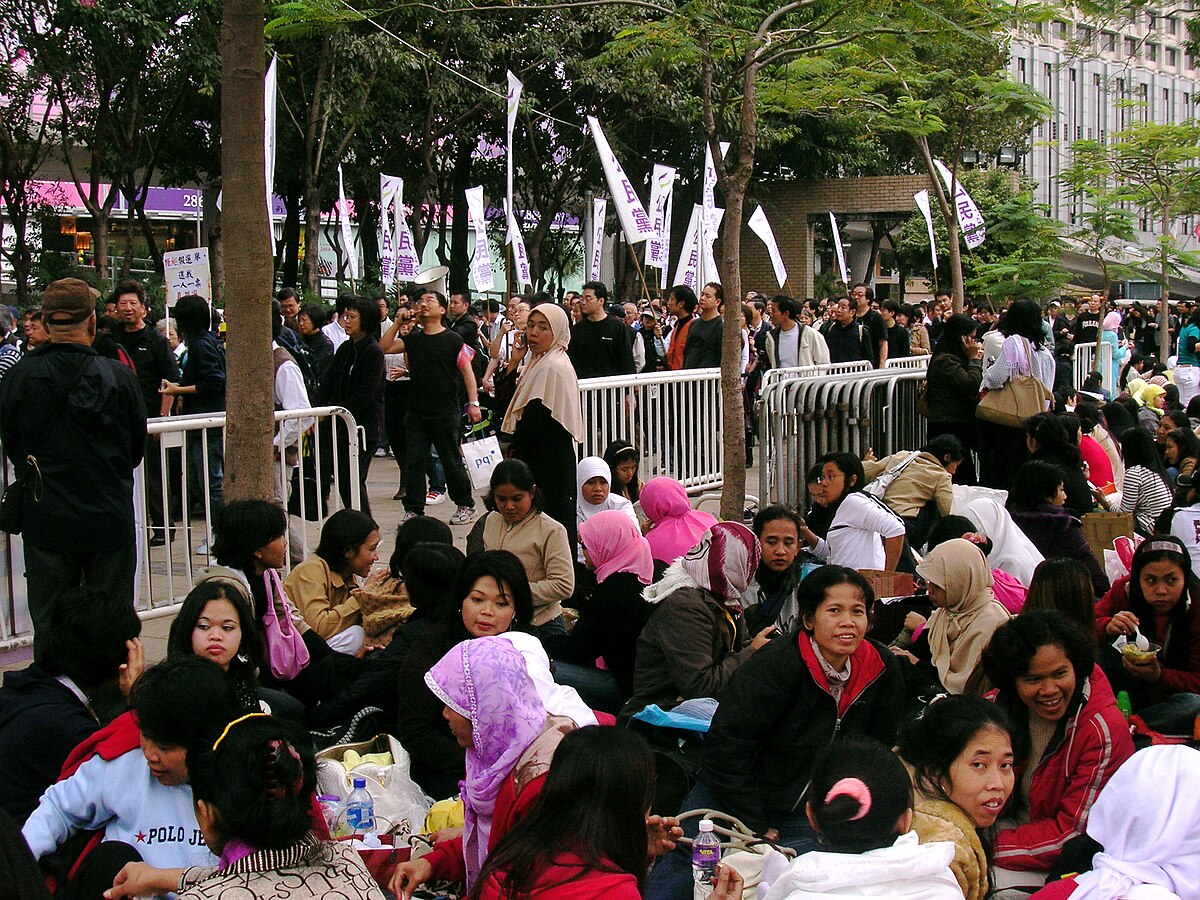

Every Sunday, Hong Kong’s public parks turn into colorful gathering spaces. Amid skyscrapers and the city’s relentless pace, thousands of Indonesian women sit together—sharing food, laughter, and stories that ease the burden of homesickness. They are part of the 150,000–170,000 Indonesian migrant workers employed in Hong Kong, most of them women between 25 and 45 years old working as domestic helpers.
They are not merely workers. They are the economic backbone of their families and unsung heroes of Indonesia’s foreign exchange. Yet behind the billions of rupiah they send home each month lies a stark reality—economic vulnerability, social isolation, and an uncertain future.
The Migrant Paradox
Hong Kong is often seen as an ideal destination for migrant workers: a minimum wage of HKD 4,870 (≈ US$620), formal employment contracts, and relatively clear legal protections. However, a decent paycheck does not automatically mean a better life.
Many Indonesian workers earn a steady income but fail to accumulate savings or long-term assets. Their wages are quickly consumed by daily expenses or remittances to families back home. Some fall into debt traps, borrowing from agencies or fellow workers to sustain consumption. This situation creates what researchers call the “migrant welfare paradox” — those who work the hardest abroad often remain financially insecure at home.
Research by Lusardi and Mitchell (2014) in the Journal of Economic Literature highlights that financial literacy plays a critical role in savings behavior and retirement planning. Individuals with low financial literacy tend to be more impulsive spenders and less prepared for the future.
In Hong Kong, the same problem prevails. As highlighted by Dewi and Yazid (2018), most Indonesian migrant workers allocate their remittances primarily for family consumption rather than long-term financial management. This reflects a lack of financial education in pre-departure training, which focuses more on domestic work skills than on financial literacy and savings discipline.
Structural Exploitation and Human Rights Issues
Financial struggles are only one side of the story. Many Indonesian migrant workers in Hong Kong continue to face exploitative working conditions and violence.
A report from the South China Morning Post (2024) revealed that in an operation called “Swordfish Operation,” Hong Kong police arrested 16 people, including 10 domestic helpers from Indonesia and the Philippines, for allegedly breaching visa conditions. In most cases, these workers were not criminals—they were simply taking on extra jobs to survive the city’s high living costs. (SCMP, 2024)
Meanwhile, Al Jazeera (2023) reported that more than 340,000 domestic workers in Hong Kong work over 70 hours per week, are forced to live in their employers’ homes under the live-in rule, and have only two weeks to find new employment if their contracts end. (Al Jazeera, 2023)
This “two-week rule” creates fear and dependence. Many workers choose to endure abusive environments rather than risk deportation or unemployment.
In more severe cases, violence turns deadly. In 2022, Business & Human Rights Resource Centre reported the case of an Indonesian domestic worker who was beaten and burned by her employer—she later won compensation worth over US$110,000 after a lengthy legal battle. (BHRRC, 2022)
Amnesty International (2013) also documented that Indonesian workers are often charged excessive placement fees and subjected to debt bondage by recruitment agencies, leaving them in servitude for months just to repay their debts. (Amnesty International, 2013)
More recently, Associated Press (2024) reported a chilling case of an Indonesian domestic worker murdered by her British employer in Hong Kong—a stark reminder that migrant labor is still fraught with grave human rights risks. (AP News, 2024)
These incidents illustrate that the problems of migrant workers extend far beyond economic issues—they expose systemic inequalities and persistent violations of human dignity.
Empowerment from the Ground Up
Despite these challenges, many Indonesian migrant workers have begun to organize grassroots empowerment initiatives. Communities of workers now conduct financial literacy classes, entrepreneurship training, and cooperative savings groups.
Organizations such as the Asian Migrants’ Coordinating Body (AMCB) and the International Domestic Workers Federation (IDWF) play an essential role in providing legal advocacy, education, and solidarity networks.
In financial literacy workshops I helped design with Indonesian worker communities in Hong Kong, participants learn practical budgeting techniques using the “50/30/20 rule” (50% needs, 30% wants, 20% savings), the importance of emergency funds, and how to create personal retirement plans.
These programs align with findings by Moorthy et al. (2012), who argue that structured financial planning significantly enhances migrant workers’ economic security and retirement preparedness. Similarly, Ajzen’s (1991) Theory of Planned Behavior emphasizes that financial behavior change depends on intention, self-control, and supportive social norms. Through collective learning, migrant workers are building a new social norm—from impulsive consumption toward disciplined financial behavior.
Toward Structural Solutions
Empowerment alone is not enough. Indonesia must pursue structural reforms and bilateral agreements to ensure the welfare of its migrant workers.
First, the government should establish a Migrant Pension Scheme, in partnership with BPJS Ketenagakerjaan (Indonesia’s social security agency) and national banks. Workers could automatically contribute a small portion of their monthly salary toward long-term savings and retirement funds.
This aligns with Kimiyaghalam, Safari, and Mansori (2017), whose research shows that institutional support and access to formal financial systems are key drivers of successful retirement planning among migrant workers in Malaysia.
Second, Indonesia’s pre-departure training should include mandatory financial education. As Lusardi and Mitchell (2014) note, experiential financial training—using real-life simulations and behavioral exercises—is far more effective in shaping saving habits than traditional lectures.
Third, stronger bilateral labour agreements between Indonesia and Hong Kong are urgently needed. The government must negotiate clauses that guarantee weekly rest days, communication rights, and housing flexibility — measures consistent with international standards for domestic work as set out in ILO instruments and guidance (Convention No. 189 on Decent Work for Domestic Workers and accompanying ILO reports and guidance)
Additionally, financial institutions in Indonesia should develop “digital migrant investment accounts”, enabling workers to save, buy mutual funds, or start microbusinesses securely—without having to return home.
A Shared Responsibility
Protecting migrant workers is not solely the responsibility of the state; it is a shared moral duty. Families in Indonesia must learn to respect the limits of remittances and support financial discipline rather than demanding constant transfers.
At the same time, the media should shift its narrative—from portraying migrant workers as mere “remittance heroes” to recognizing them as individuals with rights, dreams, and agency.
From Heroes to Owners of Their Future
Indonesian migrant workers in Hong Kong have contributed immensely to national growth. Their remittances stabilize family livelihoods and strengthen Indonesia’s foreign reserves. Yet their contributions have not been matched by adequate protection or financial inclusion.
It is time for the government and society to act—not only to praise them but to ensure their long-term security and dignity.
Through financial literacy, social protection, and inclusive policies, these workers can evolve from vulnerable laborers to empowered economic actors.
As Brandstätter (2005) aptly said, “Saving is not merely an economic act—it is a psychological discipline.” Financial empowerment is not only about earning more but about cultivating the mindset to own one’s future.
If that transformation takes place, the term “remittance hero” will no longer be symbolic—it will represent a reality: that they are not just senders of money, but owners of their destiny.
To add the opinion, you can see about GEMA NUSANTARA